Teamsters, DSP Employees, and EPIQ Careers - Part 2
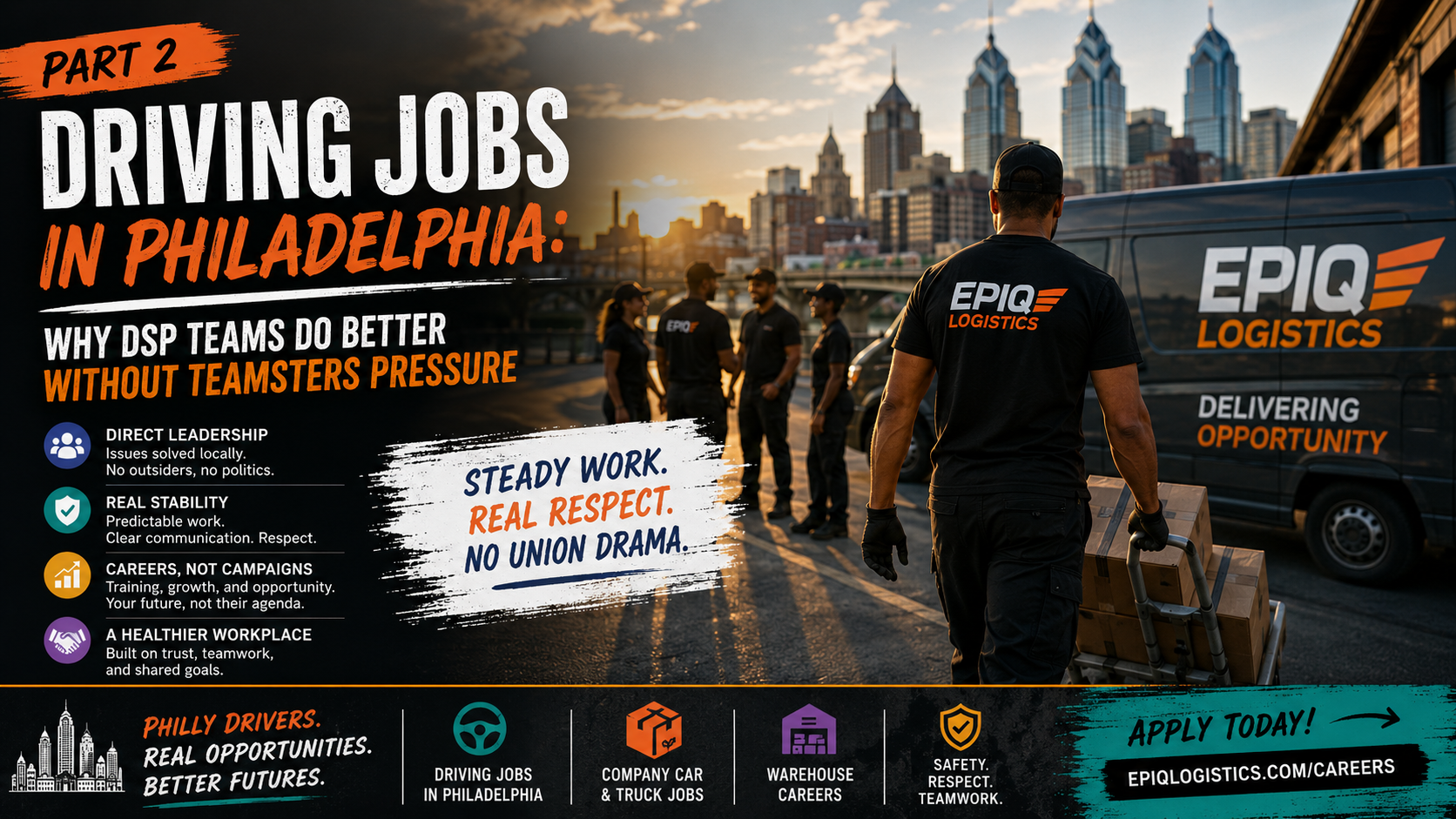
Driving Jobs in Philadelphia: Why DSP Teams Do Better Without Teamsters
Driving Jobs in Philadelphia, Part 2: Why DSP Teams Do Better Without Teamsters Pressure
If Part 1 made one point clearly, it was this: driving jobs in Philadelphia should be about opportunity, not union drama. Part 2 matters because the Teamsters have not treated Amazon as a side project. Under General President Sean O'Brien, the union has made Amazon one of its most visible targets, and recent Teamsters messaging shows that the campaign is not cooling down. The union talks about DSP drivers, bargaining orders, strikes, picket lines, "worker power," and national momentum. That may sound heroic in a press release. On the ground, it can feel very different to the driver who wants a steady route, a fair manager, safe equipment, and a paycheck that does not get dragged into someone else's fight.
This is where EPIQ Logistics takes a different view. We believe DSP employees are better off in a workplace where problems are handled directly, locally, and quickly. We believe a healthy business protects good jobs. We believe drivers should be treated with respect without needing a national organization to turn their workday into leverage. And we believe the Teamsters' Amazon strategy, especially the aggressive style now being celebrated by the union itself, is exactly the wrong model for people looking for driving work in Philadelphia.
O'Brien's Amazon Plan Is Not Quiet Organizing
Sean O'Brien has been blunt about Amazon. In interviews and public statements, he has framed Amazon as a defining labor fight. The Teamsters launched an Amazon Division in 2022, built a national organizing infrastructure, joined forces with the Amazon Labor Union at Staten Island's JFK8 warehouse, and has repeatedly said that delivery drivers are part of the broader campaign. In 2026, the Teamsters celebrated major organizing growth and described that growth as the result of an aggressive strategy. O'Brien said the union's energy and militancy were unlike anything else in the labor movement.
That word matters: militancy. It is not a soft word. It does not suggest a calm conversation between a driver and a manager about a schedule problem. It suggests confrontation, pressure, and a willingness to make ordinary business operations uncomfortable until the union gets what it wants.
The Teamsters would say that is the point. Their view is that Amazon is too powerful, too evasive, and too difficult to organize through ordinary channels. They argue that DSP drivers are controlled by Amazon and that Amazon should be forced to bargain. The union's Amazon Division even tells drivers that Amazon controls every aspect of the job and that organizing can force the company to negotiate.
But for a local DSP employee, that pitch leaves out the part that matters most: what happens to the daily job while the pressure campaign unfolds? What happens to the dispatcher, the route plan, the van fleet, the customer relationship, and the driver who does not want to be part of a public fight?
For candidates comparing driving jobs in Philadelphia, that question should come before any slogan.
When Organizing Becomes a Show of Force
That matters because logistics already runs under pressure. Routes have to leave. Vans have to be inspected. Packages have to arrive. Drivers have to stay focused. When a workplace becomes a stage for confrontation, ordinary employees can get caught in the middle whether they asked for it or not.
This is why EPIQ Logistics believes a direct, non-union workplace is better for DSP employees. A driver with a concern should not have to join a march. A new hire should not have to decide which side of a political labor campaign they are on. A route problem should not require a camera phone, a crowd, and a chant. Good management is not perfect, but it is accountable when it is close to the work.
That is especially important for anyone looking at company car driving job in Philadelphia openings or last-mile delivery roles. The best workplace is not the loudest workplace. It is the one where people can raise issues without drama and do the job without wondering whether tomorrow's shift will become part of a national headline.
The Ugly Side of Pressure Campaigns
There is a hard truth in the Teamsters-Amazon fight: the union's public image depends on conflict. Strikes, picket lines, rallies, arrests, legal complaints, and dramatic statements create attention. Attention creates momentum. Momentum helps the union recruit. But attention does not always create a healthier workplace.
During the December 2024 Amazon strike, AP reported that workers at seven Amazon facilities went on strike during a key shopping period and that two people were taken into custody at a Queens demonstration. The Teamsters said it was a pressure tactic to force Amazon toward a labor agreement. Amazon said the union was exaggerating its support and bringing in outsiders. Amazon also publicly accused the Teamsters of harassment, intimidation, and coercion, allegations the union disputes.
Those are serious accusations, and they should be presented as accusations, not proven facts. But even the existence of that dispute tells DSP employees something important. Once a campaign becomes aggressive enough that the public conversation includes arrests, intimidation allegations, and arguments over who actually works there, the workplace has already been pulled into something heavy.
There is nothing humble about that. There is nothing neighborly about it. It is rough, it is combative, and in the eyes of many business owners and drivers, it looks ugly.
For people comparing truck driving jobs in Philadelphia, this should matter. A good logistics job should be built on training, performance, safety, communication, and respect. It should not require drivers to become props in a fight between a national union and one of the largest companies in the world.
DSP Employees Need Stability, Not a National Power Play
The Teamsters argue that Amazon's DSP model creates confusion over who is responsible for drivers. That is the union's central legal and political argument. The Teamsters have pointed to NLRB findings and complaints involving joint-employer theories, and they have said those developments could help hundreds of thousands of DSP drivers organize nationwide.
But there is another way to look at the same facts. If the Teamsters are trying to pull nearly 280,000 DSP drivers into a national organizing strategy, then every local DSP workplace becomes a possible battleground. That includes drivers who never asked for a union campaign. It includes small business owners trying to keep operations stable. It includes dispatchers who have to answer for missed routes and customer complaints. It includes applicants who simply wanted a good paying driving job in Philadelphia.
That is the part the union pitch rarely slows down to explain. When a DSP becomes part of a national test case, the business risk rises. Legal uncertainty increases. Communication becomes filtered through organizers, representatives, lawyers, press releases, and public accusations. Even if the union says it wants better conditions, the process can damage the stability that helps drivers earn.
At EPIQ Logistics, we think stability is not boring. Stability is what lets a driver plan rent, childcare, bills, school, and family time. Stability is what lets a company invest in training. Stability is what turns a job into a real path.
That is why drivers searching for driving work in Philadelphia should ask a practical question: will Teamsters involvement make my actual day better, or will it put my workplace inside a larger power play?
Direct Leadership Beats Outside Pressure
A direct workplace is not a promise that nothing ever goes wrong. Any honest logistics company knows the work is difficult. Weather changes. Traffic gets ugly. Routes can run heavy. Equipment needs attention. New drivers need coaching. Experienced drivers want better opportunities.
The difference is how problems get solved.
In a direct workplace, a driver can speak to a manager. A dispatcher can adjust. A training issue can be corrected. A safety concern can be handled without waiting for a grievance process or public campaign. Strong performers can be recognized based on what they actually do every day.
In a union-pressure workplace, too many conversations become formal, political, or adversarial. The driver may be told that the real answer is pressure. The manager may be treated as the enemy. The DSP may be portrayed as part of a system rather than a local team of people trying to run a good operation. That framing may help organizers. It does not necessarily help the person behind the wheel.
This is why EPIQ Logistics believes DSP employees are better off without Teamsters involvement. Not because drivers should accept poor treatment. The opposite. Drivers deserve better than being turned into bargaining chips. They deserve leaders who listen, clear standards, sensible schedules, and a business healthy enough to keep providing opportunity.
For someone evaluating warehouse jobs in Philadelphia or stepping from warehouse work into delivery, that distinction matters. Logistics is a team sport. Warehouse teams, dispatch teams, fleet support, and drivers all depend on each other. When an outside organization teaches people to see the workplace as a battlefield, teamwork gets harder.
The Teamsters Sell Power, But Drivers Need Peace
The Teamsters' message is simple: join us, build power, force change. It is emotionally strong. It sounds good in a chant. It looks good on a sign. But power is not the same as peace, and peace matters at work.
Peace does not mean silence. It does not mean drivers should ignore real issues. It means there is enough trust to fix problems without turning every disagreement into a campaign. It means a driver can come to work focused on doing the job well. It means applicants looking for driving jobs in Philadelphia can choose a company because of the opportunity, not because it has become a symbol in somebody else's fight.
The Teamsters' own language tells drivers what kind of energy they are bringing. Aggressive organizing. Militancy. Pressure. Strikes. Public demands. Marches. Picket lines. That may be the union's brand. It should not have to be your work life.
At EPIQ Logistics, we would rather earn trust directly. We would rather talk through problems without a crowd. We would rather improve training than stage a confrontation. We would rather build careers than build tension. That approach is not flashy, but it is healthier.
If you want a company car driving job in Philadelphia, ask yourself what kind of environment will help you succeed. Do you want a workplace where every issue is pulled toward conflict, or one where leaders are expected to solve problems before they explode?
Why This Matters for Philadelphia Drivers
Philadelphia workers are practical. They know the difference between real respect and loud talk. They know a paycheck matters. They know a good manager matters. They know steady hours matter. They know promises are easy and stable jobs are harder to build.
That is why this debate matters for anyone comparing truck driving jobs in Philadelphia, last-mile delivery roles, driving work in Philadelphia, and warehouse jobs in Philadelphia. The Teamsters may offer a dramatic story, but a job is not a drama. A job is where you build your reputation and support your family.
The union's aggressive Amazon strategy may help the Teamsters grow. It may help Sean O'Brien prove that his union is powerful. It may help organizers create pressure in court, in the press, and at delivery stations. But DSP employees should ask whether it helps them day to day. Does it make the van safer tomorrow? Does it make the route clearer? Does it protect a small operation from disruption? Does it build trust between the people who actually work together?
At EPIQ Logistics, we believe the better answer is direct employment culture, strong communication, local accountability, and a business that stays healthy enough to invest in its team. A good paying driving job in Philadelphia should not come with political baggage. It should come with clear expectations, fair treatment, dependable leadership, and room to grow.
If you are looking for driving jobs in Philadelphia, choose the workplace that is focused on you, not on using you. Choose the team that wants to solve problems with you, not turn your job into a public fight. Choose steady work over noise. Choose direct leadership over outside pressure. Choose a company that believes DSP employees are better off without the Teamsters standing between drivers and the people responsible for helping them succeed.
Apply today through the EPIQ Logistics careers page and see what a healthier logistics workplace can feel like.